
 English
 Русский
 Español
 Français
 Deutsch
 简体中文
 Árabe
 Português
 日本語
 한국어
 हिंदी
 Prancis
 Türkçe
 Tiếng Việt
 Italiano
 ไทย

How to Improve Rotary Kiln Brick Lining Efficiency with Bricking Machines
Refractory brick installation is one of the most time-consuming stages of rotary kiln maintenance. When a kiln needs relining, the maintenance team must complete the work within a limited shutdown period. Slow installation can directly increase downtime and labor costs.
Manual brick installation can also become difficult inside large-diameter kilns. Workers need to carry, position, adjust, and support refractory bricks repeatedly. As the working area becomes larger, maintaining consistent brick alignment becomes more difficult.
This is where Bricking Machines can provide a practical solution.
Why Manual Brick Lining Becomes Difficult
In a rotary kiln, refractory bricks must form a stable circular lining. Each brick needs to be positioned correctly against the previous course.
With manual installation, workers often need temporary supports and repeated adjustments. Small positioning errors can accumulate as the lining progresses.
The problem becomes more obvious when the kiln diameter increases or the working space is restricted.
A maintenance contractor once described the situation after a large kiln shutdown:
“The brick quality was not the main problem. The time required to position and support each section was slowing the entire project.”
This experience shows that installation efficiency depends on more than the quality of the refractory bricks.
A Practical Case: Improving Installation During Kiln Maintenance
In one rotary kiln maintenance project, the original installation relied heavily on manual positioning. Workers spent considerable time adjusting each section before continuing with the next course.
The project team introduced a Brick Lining Machine to provide temporary support during installation.
Instead of relying entirely on manual support, the machine helped maintain the required working position while the refractory bricks were installed. Workers could concentrate more on brick alignment and joint control rather than continuously supporting the lining.
The main improvement was not simply faster brick placement. The working process became more organized, reducing repeated adjustments during installation.
The contractor's feedback was straightforward:
“The machine made the installation process easier to control, especially when several workers were working around the same section.”
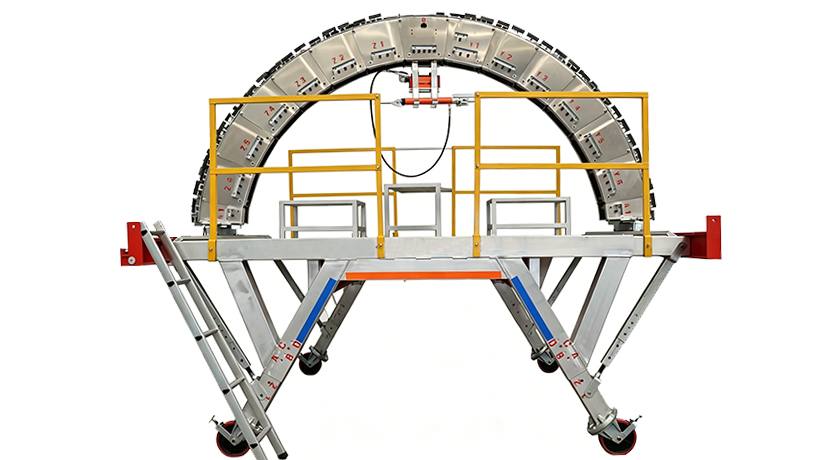
How Bricking Machines Improve Installation
A suitable Bricking Machine can provide controlled support during rotary kiln lining.
Its practical advantages include:
Supporting the brick ring during installation
Reducing repeated manual adjustment
Improving positioning consistency
Lowering physical workload
Helping maintain a continuous installation sequence
However, the machine should support the installation process rather than replace proper brick-laying skills.
Correct brick selection, joint control, ring alignment, and inspection remain essential.
Why Kiln Diameter Matters
Not every Bricking Machine is suitable for every kiln.
Kiln diameter is one of the first factors that should be considered. Brick dimensions, lining thickness, working space, and installation method also affect equipment selection.
A machine designed for one kiln configuration may not provide the same working range on another.
Before selecting equipment, the project team should confirm:
| Item | Why It Matters |
|---|---|
| Kiln diameter | Determines working range |
| Brick dimensions | Affects positioning |
| Lining thickness | Influences support requirements |
| Working space | Affects installation efficiency |
| Machine capacity | Must match project conditions |
| Installation method | Determines equipment configuration |
Custom Brick Linings Require Careful Planning
Different kiln projects may use different brick shapes, dimensions, and lining designs.
Custom Brick Linings can therefore require a different installation approach from standard brick arrangements.
Before construction begins, the brick pattern, installation sequence, and equipment working range should be reviewed together.
This preparation can prevent unnecessary adjustments after the machine has already arrived at the job site.
What to Look for in a Brick Lining Machine Factory
When choosing a Brick Lining Machine factory, buyers should look beyond the basic machine price.
The supplier should understand rotary kiln lining work and be able to discuss kiln dimensions, brick specifications, working conditions, and installation requirements.
Technical communication before delivery can be particularly important for customized projects.
Efficient refractory installation is an important part of reducing rotary kiln maintenance downtime.
Bricking Machines can help provide temporary support, improve positioning, reduce manual workload, and create a more consistent installation process.
However, successful kiln lining still depends on proper brick selection, experienced workers, correct installation procedures, and suitable equipment.
The practical lesson from field projects is simple: the right machine does not replace skilled installation—it makes skilled installation easier, more controlled, and more efficient.
Online Message
RELATED PRODUCTS

LAR develops bricking machines for safe and efficient refractory lining installation inside rotary kilns. The company designs bricking machines to improve kiln maintenance efficiency and reduce manual labor during refractory brick installation. Bricking machines help operators complete kiln lining work in a stable, controlled, and safer working environment.
LAR designs mini bricklaying machines for efficient refractory lining in small to medium rotary kilns. The company develops mini bricklaying machines specifically for kiln inner diameters from 1800mm to 2400mm. Mini bricklaying machines provide a compact and safe working platform for fast and accurate brick installation.
LAR designs rotary kiln brick lining machines for large-diameter rotary kiln refractory installation and maintenance. The company develops rotary kiln brick lining machines for kiln inner diameters from 5000mm to 6000mm. Rotary kiln brick lining machines provide a safe, stable, and efficient working platform for precise brick installation in heavy industrial kiln environments.
LAR designs hydraulic brick lining machines for high-load rotary kiln refractory installation and heavy-duty maintenance projects. The company develops hydraulic brick lining machines to improve precision, safety, and efficiency during kiln lining operations. Hydraulic brick lining machines are widely used in large industrial kilns where strong pressing force and stable control are required.
LAR designs the brick lining machine for efficient refractory installation inside rotary kilns, industrial furnaces, and high-temperature equipment. The company develops the brick lining machine to improve accuracy, speed, and safety during kiln lining operations. The brick lining machine provides stable support for brick placement under heavy industrial conditions.
LAR develops kiln brick lining machines for efficient refractory installation inside rotary kilns used in cement, metallurgy, and heavy industrial production. The company designs kiln brick lining machines to improve lining accuracy, reduce labor intensity, and enhance operational safety. Kiln brick lining machines support stable and continuous brick installation under high-temperature kiln conditions.
LAR designs brick laying machines for industrial refractory construction and heavy-duty masonry applications in kilns, furnaces, and high-temperature equipment. The company develops brick laying machines to improve installation speed, structural accuracy, and operational safety. Brick laying machines are widely used in cement plants, metallurgy industries, and refractory engineering projects.
LAR designs automatic brick lining machine systems for industrial kiln and furnace refractory construction. The company develops automatic brick lining machine solutions to improve installation accuracy, reduce manual labor, and increase working efficiency. Automatic brick lining machine technology is widely used in cement, metallurgy, and high-temperature industrial equipment maintenance.
